Why a big rug walks, and what actually stops it
A nine-by-twelve rug can travel a foot a month across a hardwood floor, and nobody ever sees it move. The mechanism is simple, and so is the fix once you know which of four things is happening.
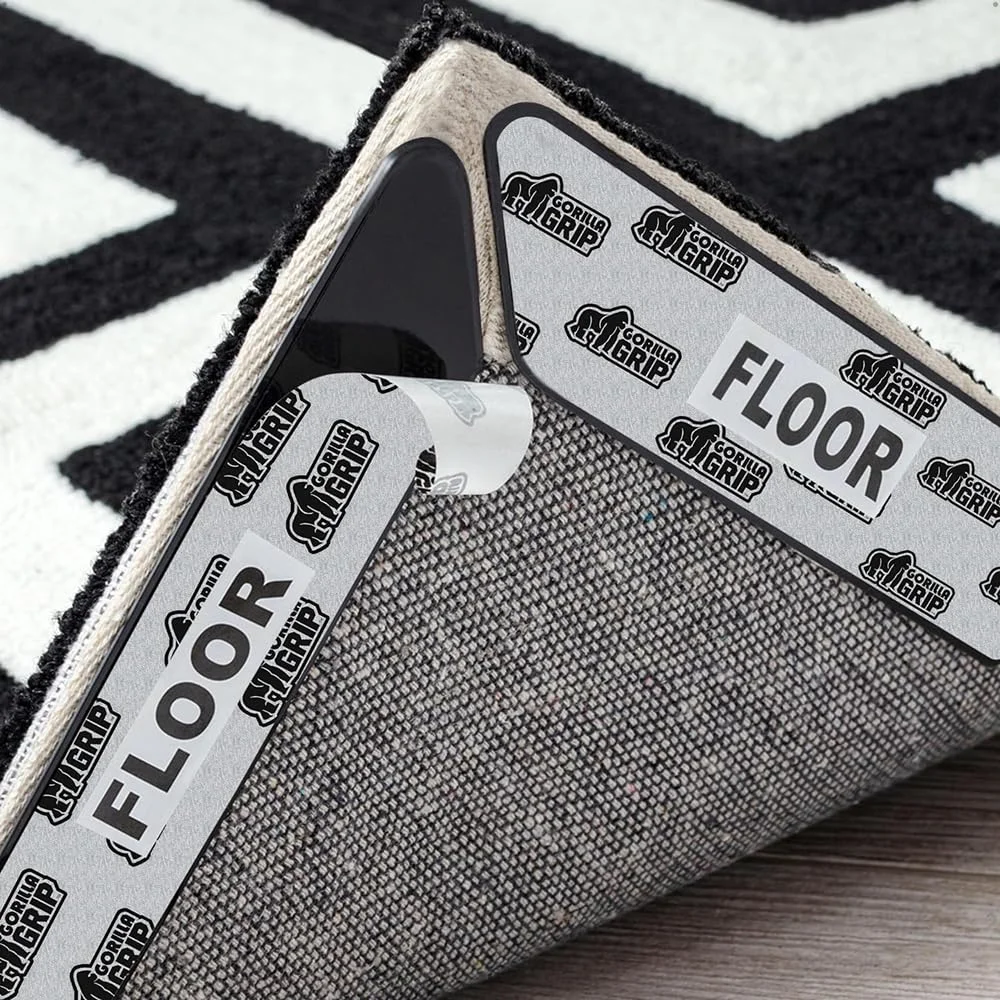
The rug has not stayed where you put it, and the long side is no longer parallel to the floorboards. One corner noses toward the doorway, while the runner that began centered in the hall now kisses the baseboard on one side and shows a crescent of wood on the other. That slow drift feels mysterious the first time you notice it, because it is not one big slide. It is a walk, and it happens one footfall at a time.
What is actually pushing it
A rug does not move in a single, graceful glide, but it travels in small increments. Each one is a foot landing and pushing sideways, or lifting with a little pull, and over days and weeks those increments add up in the direction people walk. Turn into the kitchen and the rug edges follow the habit of that turn, while working between the sofa and the sink makes the rug inch along that run.
Three facts decide whether a step becomes an increment, which are how much the rug weighs, how much friction there is between the rug and the floor, and how much the backing can flex. A stiff heavy rug on a rough floor moves least, and a light rug with a soft or slick backing on a smooth floor moves most, while in between is where most rooms live.
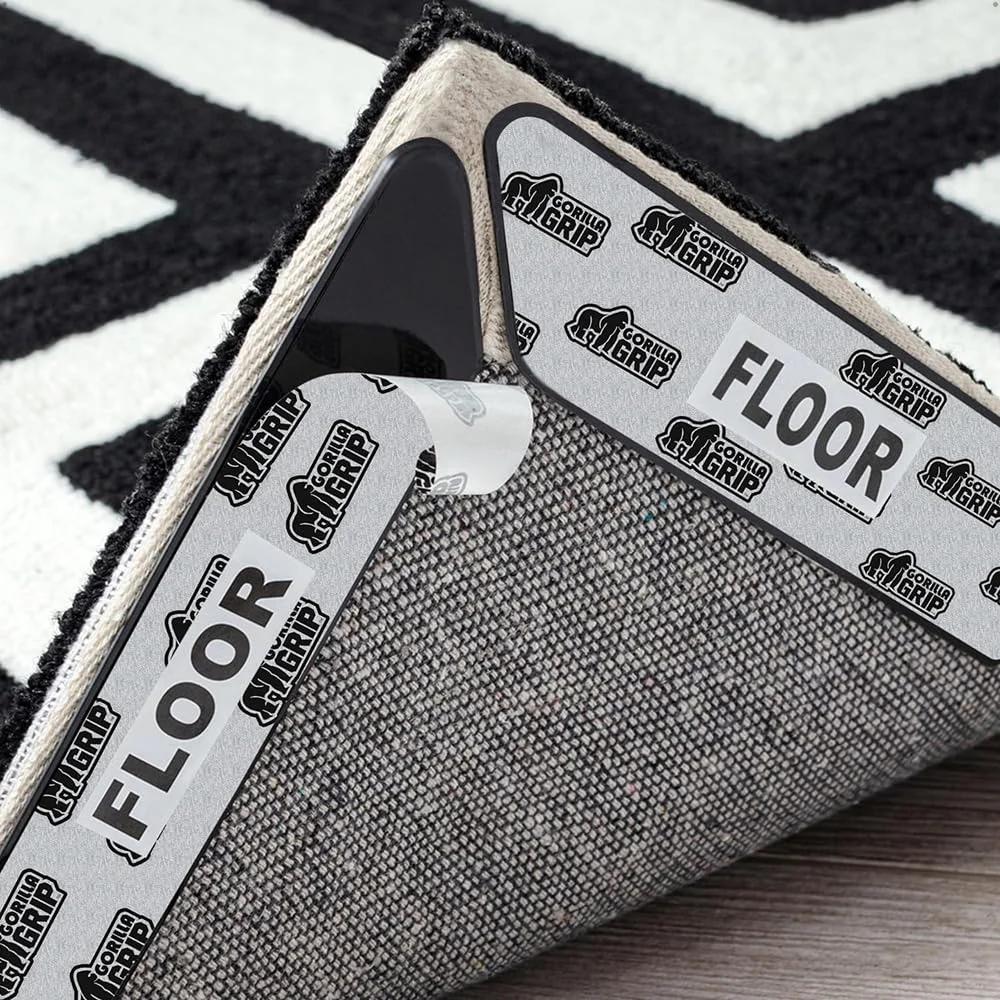
You will see the fastest creep where feet change direction: doorways, the turn at the foot of the stairs, and the crosswalk between a sofa and a kitchen. At those spots, the sideways push that starts the increment is strongest, and it repeats more often than anywhere else in the room.
A rug laid over carpet behaves differently again, because the pile under it moves with it, so a pad made for a hard floor has nothing to bite on. The fix for a rug on carpet is a different one that deals with movement in the pile itself.
A rug does not slide once, it walks in small steps.
The usual quick answers, and what they do over a year
Tape. It feels decisive to run strips around the edge or under the corners, and it can hold for a while. Over a year you usually see two things: adhesive hardens or lifts, so the rug resumes its walk, and the tape carries grit and cleaning residue that stay trapped against the finish. That film dulls a hard floor in a slow, uniform way, and on wood, anything that traps moisture between rug and finish is a way to cloud it. Tape also leaves a job for later, because you have to clean up what it leaves behind.
Velcro-style corners. Small hook-and-loop patches promise to pin the corners, and they can stop a trip edge from curling, which is useful. What they do not do is stop a whole rug from creeping, because the middle still moves under traffic, so over months you can see small buckles develop between anchored corners. The rug is fixed in four spots but still forced sideways in every step, and if adhesives are part of the system, you are still pressing adhesive against a finish and trapping whatever gets between.
A heavier rug. Weight helps, and it turns down the size of each increment, but it does not stop the process. A heavy rug on a smooth finish can still walk in a busy doorway, and weight also adds thickness. If a door needs to clear the rug, more thickness creates its own problem.
What a pad has to do
A pad is not magic, but it is a layer that does three jobs. It adds usable friction between the rug and the floor, it stiffens the system so the backing under your foot does not fold and skid with every push, and on wood it protects the finish from the rug’s own backing while staying breathable enough that moisture and cleaning residue do not sit trapped under the rug.
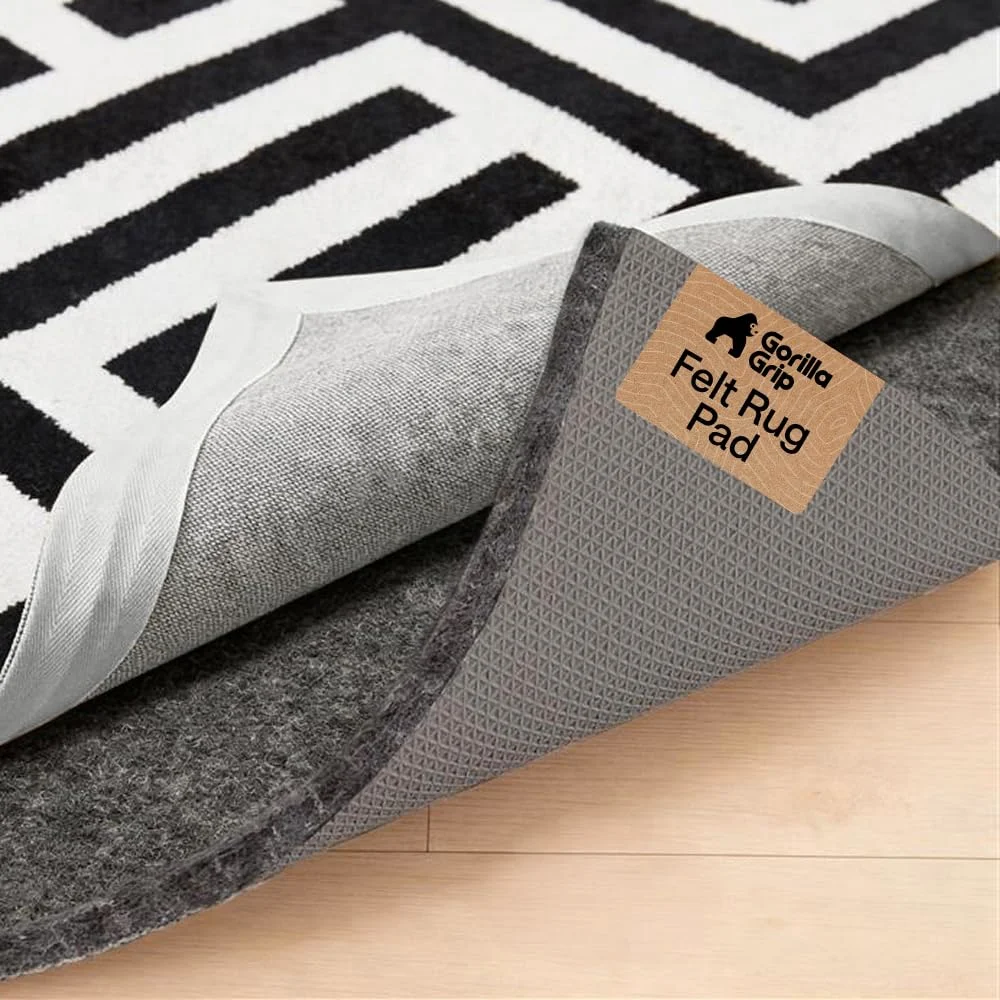
Felt bonded to natural rubber. Two layers as one, and the felt gives thickness and quiet, and it gives a thin or floppy rug some body so it behaves like a heavier one, while the natural rubber side grips the floor. This is the thickest option, and it also protects a floor from the rug’s own backing by keeping the two apart.
Thick or thin: decide by the door and by the rug itself
You choose thickness with two facts: door clearance and the rug’s body.
One thing to watch is that a thick pad creates a step up, and in a doorway or at the head of stairs that change in level should be deliberate. If a thick pad would create too much of a lip, go thin and place the rug so your walking line does not clip the edge.
Size the pad to the rug, not to the room
A pad belongs under the rug, trimmed so it never shows, and the simple rule is one inch smaller on each side. If the rug is 5 by 7 feet, the pad under it should be about 4 feet 10 inches by 6 feet 10 inches, which gives coverage for grip and support without the pad peeking out.
- Unroll the pad and the rug in the room where they live, and let both relax flat.
- If the pad is larger than the rug, center the rug on top, trace around the rug lightly, then mark a line one inch inside that trace, and cut on the inside line, but if the pad is slightly smaller than the rug already, check that it is evenly inset on all four sides.
- Place the pad rubber side down if it is a felt-and-rubber pad, and place a dual-sided gripper with the floor side down as marked, then set the rug over it and smooth from the center out to the edges.
- Step back and check door swings and the walking line, and if a door scrapes, move to a thinner pad, while if you see a strip of pad beyond an edge, trim a little more.
Hard floors and how to care for the finish under a rug
Hardwood changes with the room that surrounds it, and when the air gains moisture, boards can cup, while when it loses moisture, gaps open and some boards can split. The National Wood Flooring Association holds to simple numbers that keep a wood floor sound, which are a house between 60 and 80 degrees Fahrenheit and 30 to 50 percent relative humidity, and if you stay there you hold the floor still.
Pads come at two thicknesses in the Gorilla Grip collection for exactly this reason: the thick one where a rug needs body, the thin one where a door has to clear.
A bathroom is the one room where the rug and the floor are wet at the same time, and the sizes there are worked out differently: The bathroom floor, measured properly goes through it zone by zone.
On vinyl, laminate and sealed concrete, the same rule holds: dry, clean, then pad, then rug, and a thin gripper pad is often enough if the rug has body. In large rooms or on smooth finishes, a full-size dual-sided gripper sized to the rug adds coverage that keeps the rug sitting square.
Where and why rugs creep fastest
You see the walk most in lines of travel and at turns, because a runner that crosses a doorway will move toward the hinge side as people swing through. The turn at the foot of stairs is hostile to corners, and the outside corner takes a beating and tries to curl. Between a sofa and a kitchen you get a steady diagonal push as people pivot and set a tray down.
You can work with those facts, and place a pad that covers the full footprint of the rug so there is friction all the way to the edges. If the corner wants to curl, add a corner gripper there to hold that edge flat, but do not expect the corner piece to stop the rug from walking, because it is a trip-edge fix. In a long hallway, make sure the pad is straight and the runner is straight when you start, and if the run tends to twist over months, lift and re-square it during routine cleaning.
Rugs on carpet: what changes and what works
A rug on carpet does not creep for the same reason as a rug on wood, because the pile under it is free to move and compress, and a rubber pad meant for hard floors has nothing to hold, so it will sit and slide on the fibers below, and that is the whole reason the usual hard-floor pad fails on carpet.
What does work is a dedicated rug-on-carpet gripper, which is made to engage the carpet pile below and hold the rug above. Look for a full-size gripper designed for carpet, sized to the rug, and it should sit flat under the whole rug so the load spreads, not just at the corners. Use the same one-inch-smaller rule so it never shows, place it on a clean, dry carpet, then set the rug and smooth it from the center out.
A clear table for common floors
| Floor type | Pad to use | What to watch for | How it fails if you get it wrong |
|---|---|---|---|
| Sealed hardwood | Full-size dual-sided gripper for hardwood, or felt bonded to natural rubber if the rug needs body | Keep the house between 60 and 80 F and 30 to 50 percent RH. Floor clean and dry before the rug goes down | Moisture and residue trapped under the rug can cloud the finish. Too thin a pad under a floppy rug lets it walk |
| Engineered wood | Full-size dual-sided gripper sized to the rug | Same humidity and temperature targets as solid wood. Watch door clearance | A thick pad that fouls a door creates a scrape point. No pad lets the rug creep on smooth finish |
| Tile or stone | Felt plus natural rubber for bridging grout, or a dual-sided gripper if the rug already has body | Sweep grit before placing. Align to avoid telegraphed grout lines | Corners can curl over tall grout lines if the pad is too thin. Grit under the pad acts like sandpaper |
| Vinyl or laminate | Thin rubber gripper or dual-sided gripper sized to the rug | Floor fully dry after cleaning. Check that the pad lies flat with no ripples | Moisture held under the rug dulls appearance over time. A thick pad can make an unwanted step-up at doors |
| Sealed concrete | Thin or medium pad depending on rug body. Dual-sided for large rugs | Watch for damp slabs in basements. Dry thoroughly before placement | Damp trapped under a rug clouds or darkens the surface temporarily and encourages creep |
| Wall-to-wall carpet | Dedicated rug-on-carpet gripper sized to the rug | Clean carpet first. Use the one-inch-smaller rule | Hard-floor pads have nothing to bite on and the rug continues to creep |
Placing and trimming with care
Trim in light passes, because pads cut cleaner when you avoid big bites, and use long scissors and work the pad on a flat, firm surface. Keep the cut inside your mark, then test by setting the rug and looking along the edge for any reveal. One more trim is easy, but adding back is not.
If the rug covers a register or an underfloor heating run, favor a thin pad, because heat needs a path, and a thin gripper lets heat move and keeps doors clearing.
A maintenance habit that helps
Grit under a rug behaves like an abrasive, and on hard floors it rubs between pad and finish, while on carpet it hides in the pile and resists. Make a habit of lifting the rug and pad together once in a while, vacuum the floor, wipe the pad faces with a dry cloth, let the floor dry if you spot-cleaned, and set the pad and rug back down straight. That small routine keeps the grip you paid for.
If a corner starts to curl in a busy turn, a corner gripper is useful because it pins that edge flat, but remember what it does and what it does not do. It is there to stop a trip edge, and it does not hold the whole rug still in a walking line.
Safety, judgment and when to remove a rug
Loose throw rugs are a known hazard, and the National Institute on Aging advises against them and asks that every carpet in a home be fixed firmly enough that it cannot slip. The Centers for Disease Control and Prevention names throw rugs and clutter among the home hazards behind falls, and it reports that more than one in four people aged 65 and over falls each year, which adds up to about three million emergency department visits and about a million hospital admissions.
Those numbers argue for attention, but they are not a promise that any pad or technique can remove risk. The honest call in some rooms is the hard one, and if a rug sits in a walking line used by someone who is unsteady on their feet, it can be worth losing the rug rather than gripping it better. Bare flooring with clear paths is the safest footing you can give a person who needs it.
Why rugs still move in good rooms
Even with a good pad, rugs in the hardest working lanes can drift by small degrees, which does not mean the system is wrong because the lanes are busy and the physics do not take days off. Heavy feet at a turn will always push, so the job is to turn a shove into a nudge and to keep the rug square.
Help it out by rotating a rug a quarter turn twice a year to even out wear and any drift, and in a hall, re-square the runner when you clean. Under a table, check that chair legs land fully on the rug and not half on and half off, which can lever an edge up. These are quick touches, and they prevent the slow creep from becoming a visible skew.
The floor comes first
Everything under a rug needs to be friendly to the floor, and that is the point of using a proper pad. The right pad grips without gluing, gives body without bulk where a door must clear, and breathes so moisture and cleaning residues do not sit trapped. The rug then does its job. It softens sound and defines a space. It stays where you intended.
Sizes run from 2x3 up to 9x12 feet across the Gorilla Grip catalog, and every one of them is meant to be cut down rather than left to show at an edge.
If you are in doubt between two pad types, match to the facts you can measure: door clearance, rug body, the floor material, and heat under the floor or not. Start there, fit one inch in from every edge, and place the rug on a clean, dry surface, and the walk that made you notice the problem slows to a pause and the room feels finished again.
One button, the whole Gorilla Grip range
Every size, colour and pack count in Gorilla Grip essentials sits behind this button, with the current price beside it. Pick your floor, check the size against a tape measure, and it ships from our retail partner.